
Turn your product data into AI sales.
info.link/answers creates verified, machine-readable FAQs that AI assistants find, understand, and cite. So when a shopper asks ChatGPT, Gemini, Perplexity, or Amazon Rufus about your product or service, the answer comes from your brand.
Trusted by leading brands. Built with GS1.




From the team behind info.link/labels. Live on 1 billion+ packs worldwide.
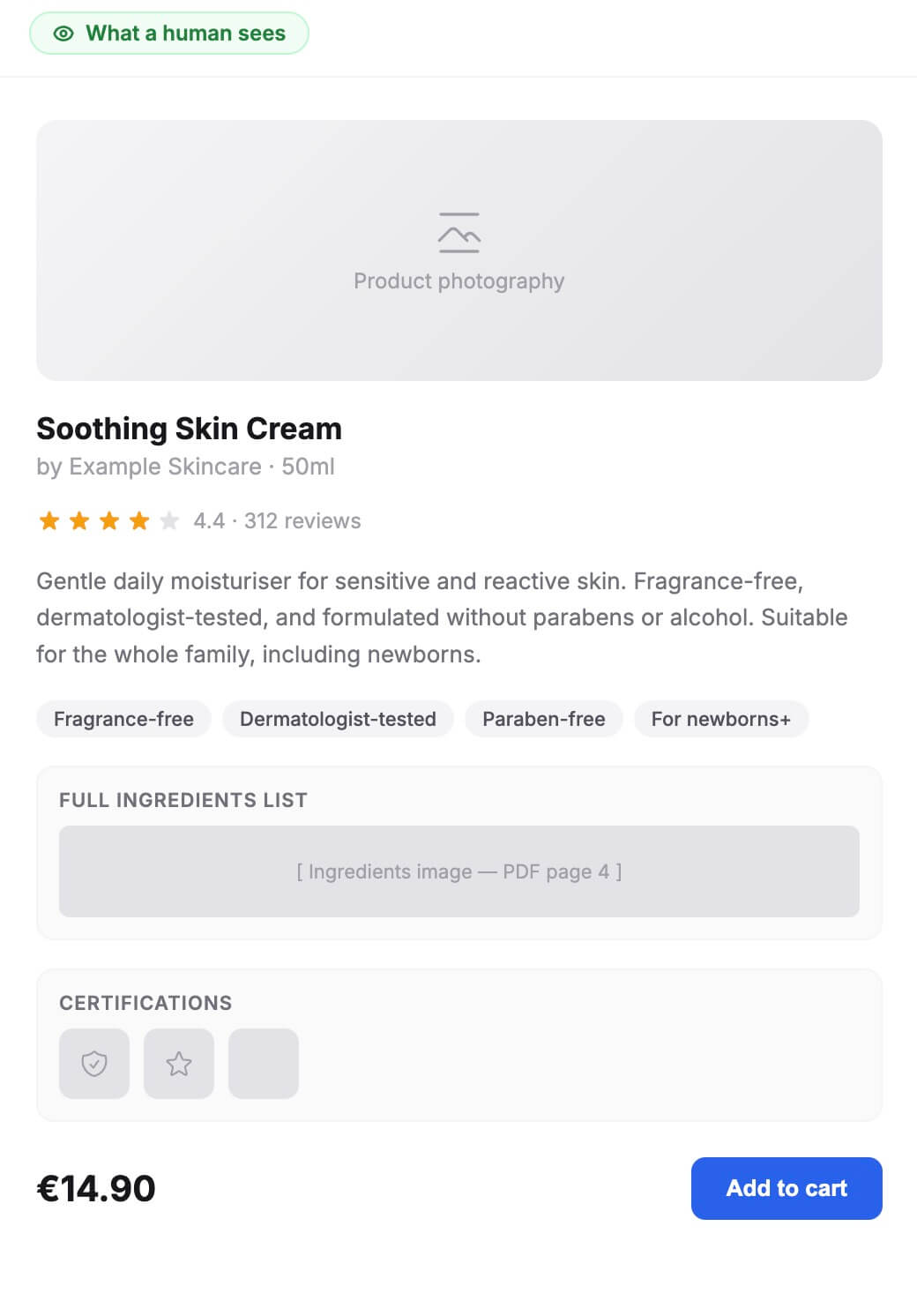
Your product page looks great to humans.
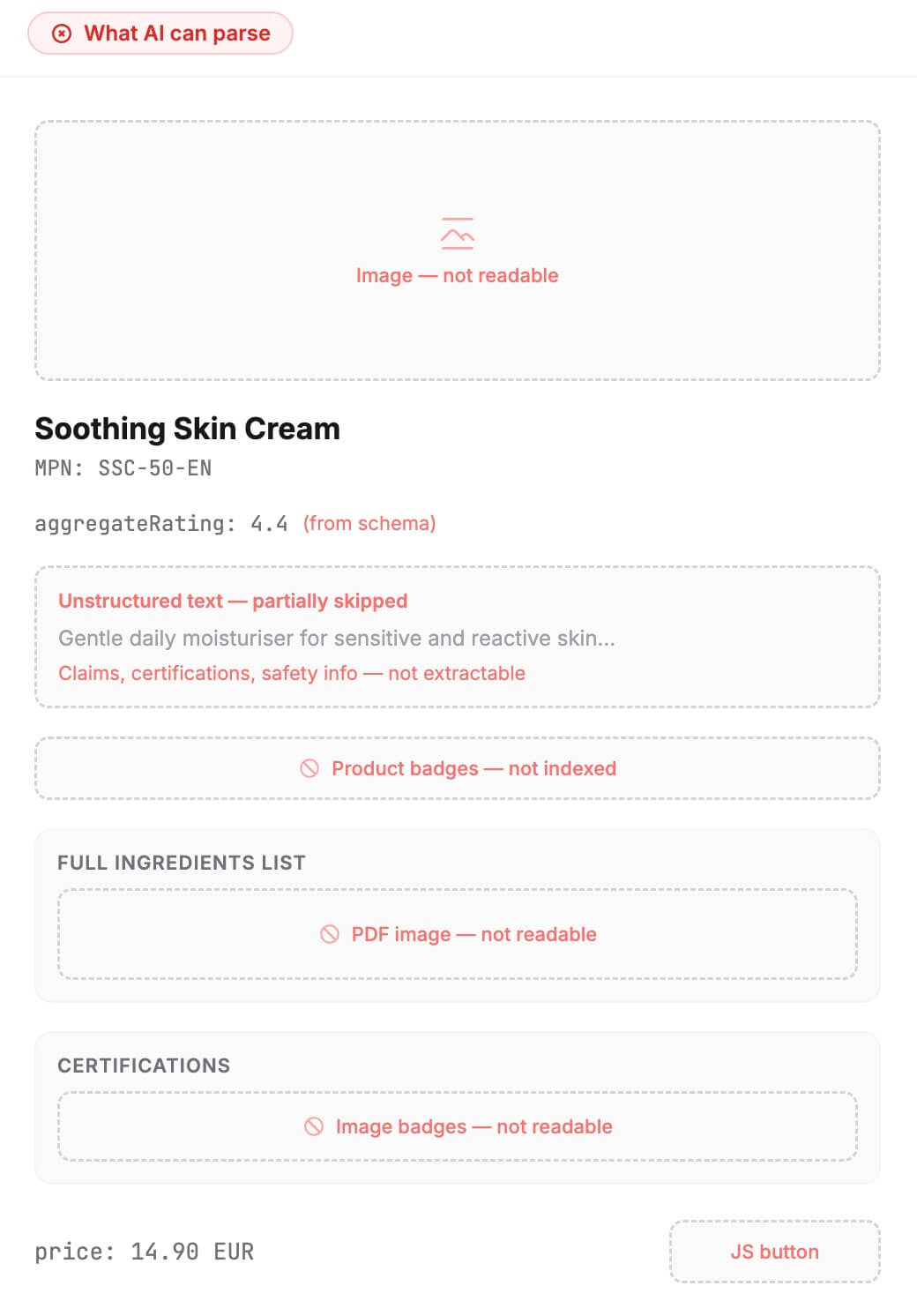
To AI, it's almost empty.
AI assistants can't read images, PDFs, or badges. They skip unstructured text. What looks like a complete product page to a shopper is a near-blank slate to an AI.
The shift is here
USD 750bn in consumer spend will flow through AI assistants by 2028, more than Amazon and Shopify combined. 73% of shoppers already use AI, and up to 83% of queries end without a click. The answer happens inside the AI.
Most product pages fail the AI test
AI reads your PDP and sees almost nothing: images unreadable, certifications invisible, ingredient PDFs skipped. A page packed with rich content for humans is, to an AI crawler, barely more than a product name and a price.
If you don't fill the gap, AI will guess
Without structured data, AI pulls from Reddit, outdated PDFs, and competitors. Up to 27% of AI outputs in technical searches contain fabricated information. Courts have already held brands liable for what AI said about their products.
Why FAQs are the answer
AI assistants don't rank pages. They retrieve specific passages and synthesise an answer. And they're especially good at matching a user's question to an existing question-answer pair. That makes FAQs the single most effective format for AI visibility. Not any FAQs. FAQs built for how AI actually works.
How LLMs work
LLMs generate text by predicting the most probable next word. They need structured, high-quality input to produce accurate output. If your product data lacks structure, so will the output.
How consumers search
People ask AI full questions in natural language: “Is this safe for my baby?”, “Which one is best for dry skin?”, “Does it contain parabens?” Each product can generate 30 to 50 unique consumer questions.
How AI retrieves answers
AI matches a user's question to the most semantically similar content it can find. A well-structured FAQ with a clear question heading and a concise, factual answer is the format AI retrieval is designed for.
The Perfect Product-FAQ Playbook
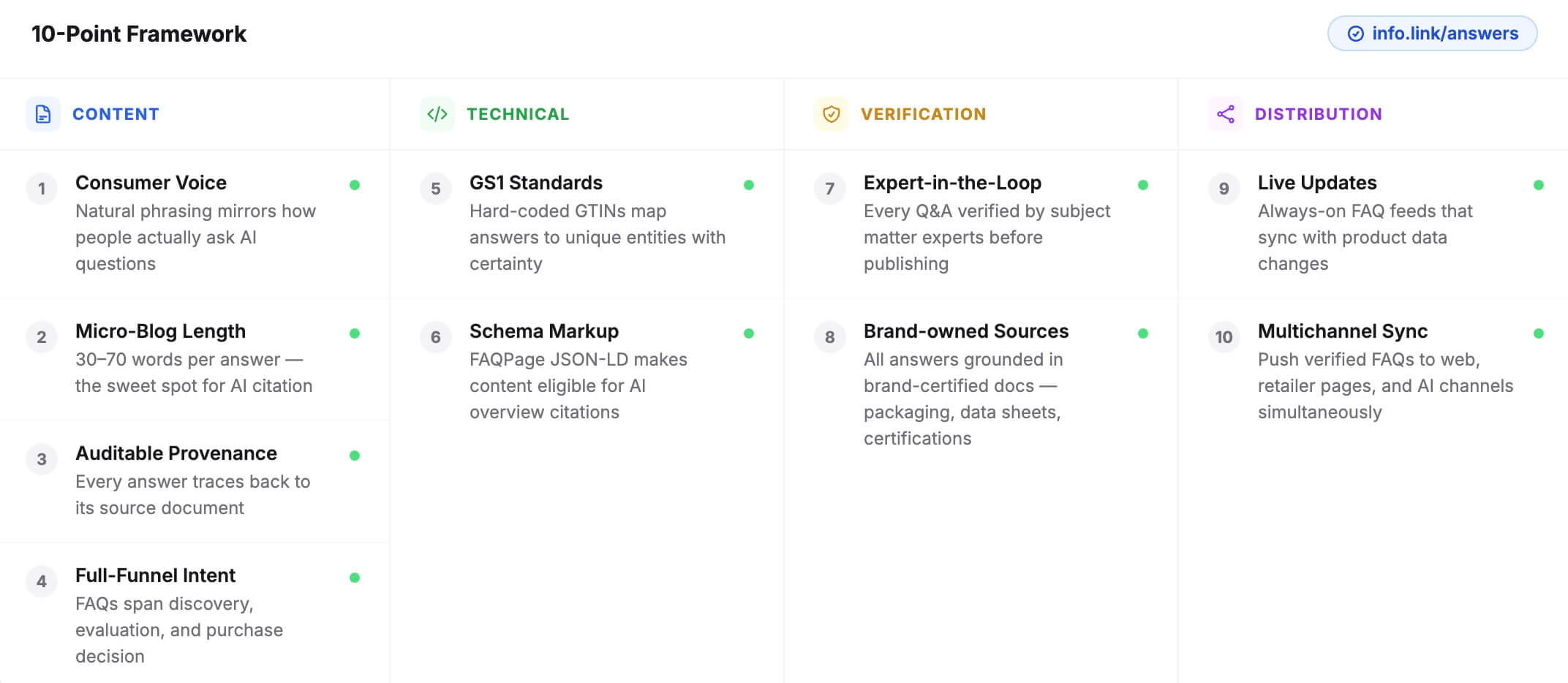
Most FAQs today meet about 2 out of 10 requirements for AI readiness. The gap between what brands have and what AI needs is wide. The 10-Point Playbook covers four dimensions: content quality, technical markup, verification, and distribution.
“Adding verifiable statistics, expert citations, and authoritative sources to content increases AI visibility by up to 40%.”
– Princeton University, GEO-bench study
In e-commerce, AI search sources 80% of answers from brands and retailers. The data your brand provides is the primary input AI works with. The question is whether you've structured that data for retrieval.
From raw product data to verified, machine-readable FAQs
info.link/answers takes you from raw product data to verified, machine-readable FAQs in six stages. The entire process is auditable end-to-end, with an expert-in-the-loop to review and approve before anything goes live.
Map your product universe
Define your brand, categories, and products. The platform builds a semantic graph that mirrors your portfolio: brand-level facts flow down to categories, category-level context flows down to products. Upload once at the top, and every product below inherits what it needs.
Connect your sources
Upload the materials you already have: product pages, packaging, certifications, data sheets, reviews. Paste text directly or add URLs. The platform extracts facts, claims, audiences, usage contexts, safety concerns, and comparison cues across three layers of depth.
Build deep understanding
The platform analyses your sources across seven dimensions: identity, differentiation, audience needs, claims and evidence, concerns and tensions, consumer discovery paths, and non-obvious insights. This isn't a content writer skimming your website. It's a structured analysis of everything that matters about your product.
Design the question architecture
The platform maps 12 to 25 topics per product across the full buyer journey, from first discovery through evaluation to purchase decision. All in consumer language, not marketing jargon. Every question passes the “friend test”: would a real person actually ask this out loud?
Generate and verify answers
AI drafts answers grounded in your sources. Every answer leads with a direct response. Every answer names the product in its first sentence. Every claim traces to a specific source document.
No marketing fluff. No “discover” or “experience.” Just clear, honest product information that AI systems can confidently cite. The platform flags compliance-sensitive topics and never auto-answers them.
Publish entity pages
Each page carries 101 machine-readable signals. FAQPage schema. W3C provenance tracking, the same standard used in academic publishing and government data. GS1 product identifiers. Full WCAG 2.2 accessibility. Deploy as standalone pages on your own domain or embed directly into retailer product pages.
See what an entity page looks like
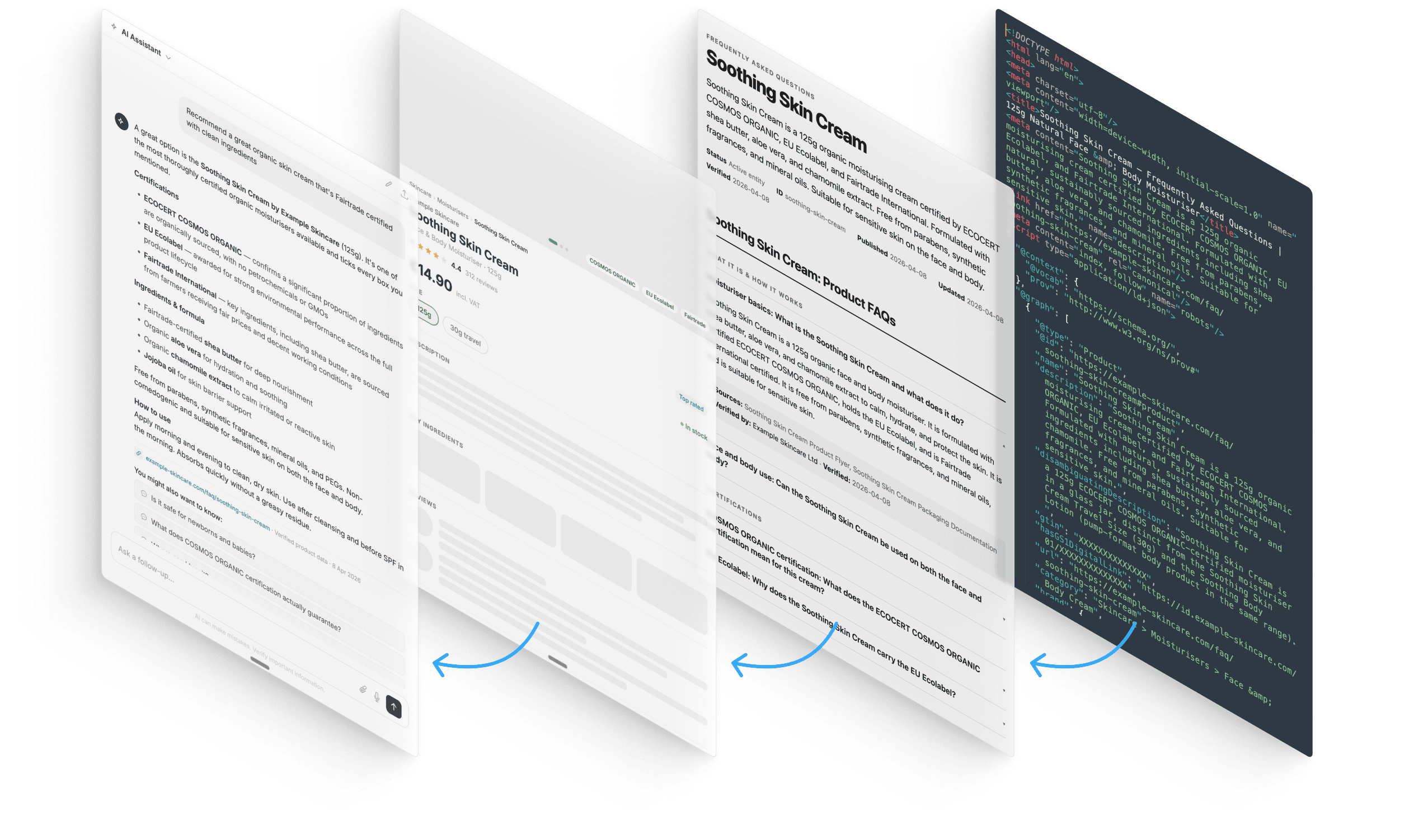
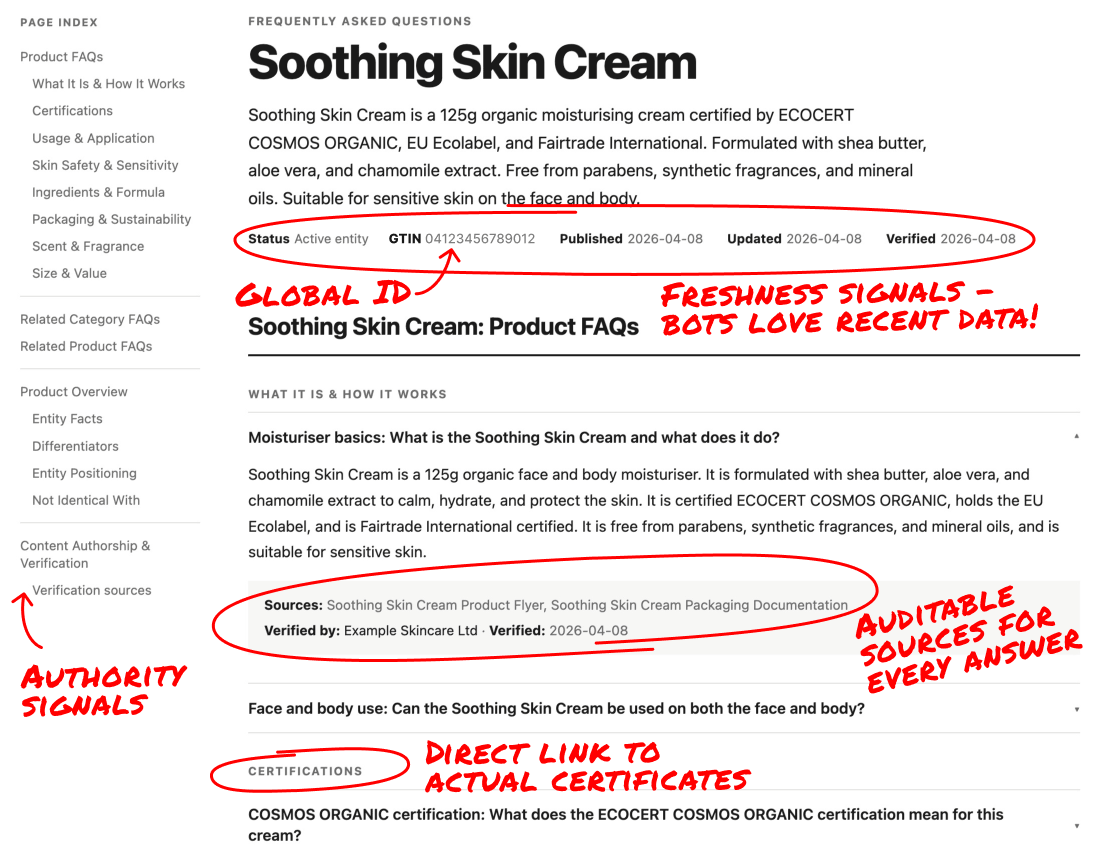
This is what AI sees when it finds your product. Every entity page is a self-contained knowledge unit. Structured enough for machines to parse. Clear enough for humans to read. Verified enough for AI to cite with confidence.
Every answer traces to its source
Each FAQ answer carries a visible provenance footer: the source documents it drew from, who verified it, and when. AI systems see this too, in the structured data.
Machine-readable from top to bottom
FAQPage schema, Product schema, Organisation schema, GS1 identifiers, W3C PROV-O provenance chains, all embedded as JSON-LD. When an AI crawler reads this page, it gets structured data, not guesswork.
Built for every product tier
Entity pages work across three levels, linked as a knowledge graph: brand, category, and product. A bot landing on any page gets the full picture, from who makes it to where it sits in the range.
Everything your products need to win in AI search
Give AI the facts before it guesses
Structured, brand-authorized answers give AI crawlers a reliable source to draw from, rather than guessing.
Spot gaps before competitors do
An evidence audit maps which product questions lack source material today, so you know exactly where to act first.
Structured for every AI assistant
Formatted to match what ChatGPT, Gemini, and Perplexity expect, your answers become their most likely source for product questions.
Built on GS1 standards
Anchored to globally trusted product identifiers, AI is far less likely to mix up facts from different products.
Lives on your domain
Every FAQ page sits under your own canonical URL, so citations and AI-referred traffic come back to you.
Drops into existing pages
Embed verified FAQs directly on your product detail pages without redesigning a single thing.
Reviewed by human experts
Every answer passes a specialist review before it goes live, protecting your brand from errors at scale.
Future-proof from day one
Served as an API and MCP endpoint, your product knowledge is ready for AI agents and whatever comes next.
One source, every AI channel
You structure your product data once. info.link/answers distributes it everywhere AI looks.
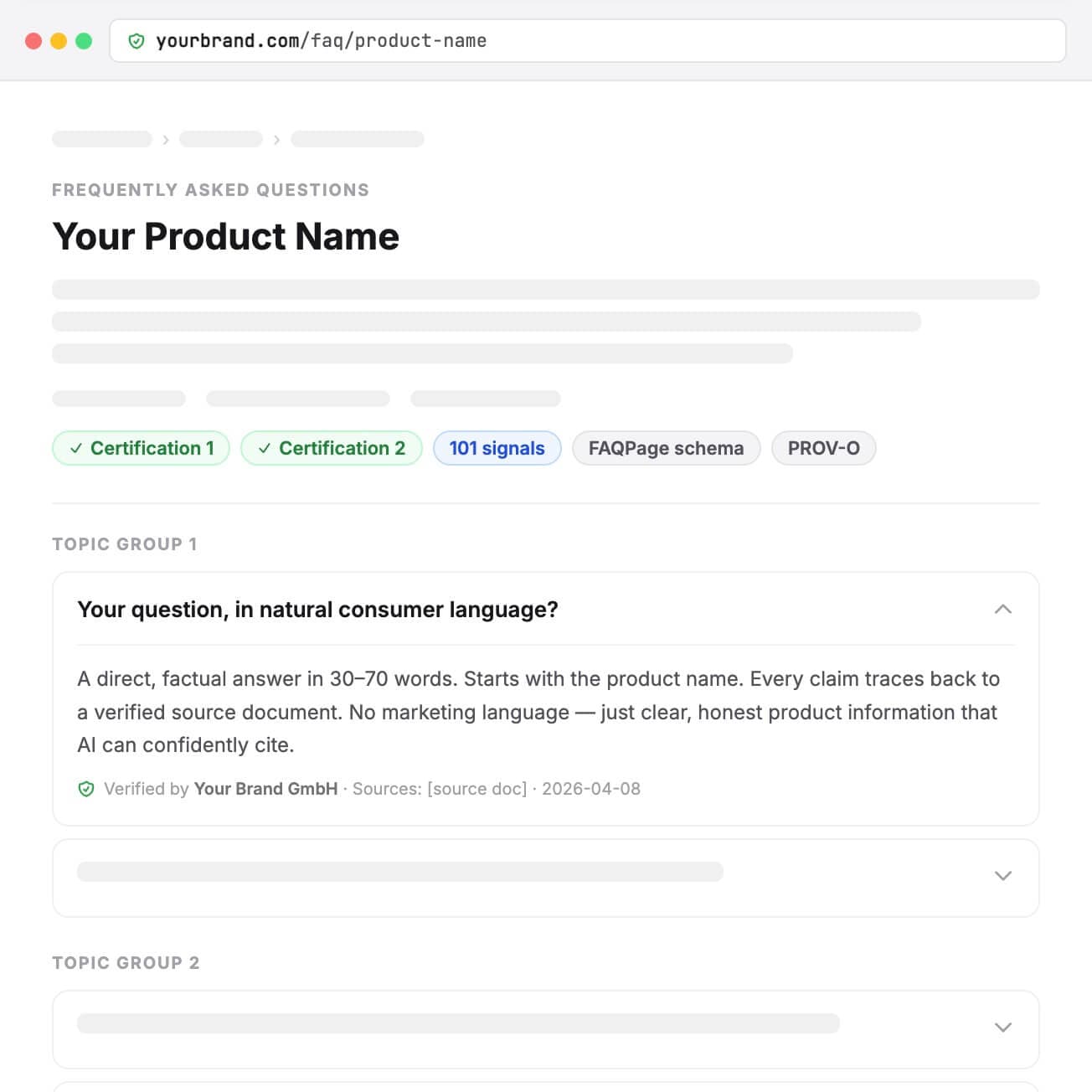
Standalone FAQ pages
Full FAQ pages published on your own domain at /faq/product-name. Own H1, own canonical URL, complete JSON-LD in the page head. Search engines and AI crawlers can find, index, and cite them independently.
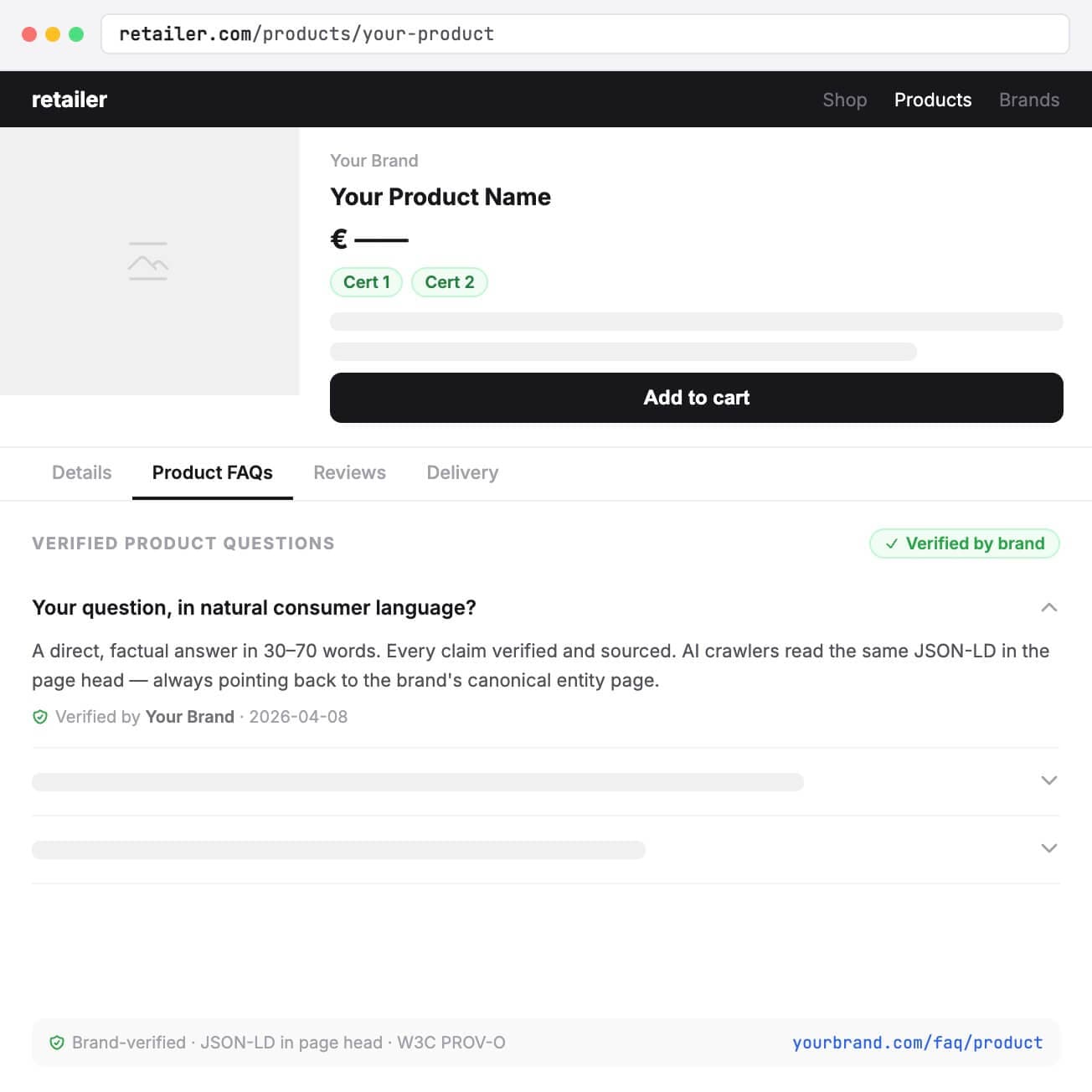
Embedded in product/service detail pages
The same verified FAQs, embedded directly on your category pages or product detail pages, showing only the questions relevant to that specific product or category. Heading levels adapt to the host page. JSON-LD stays in the page head so AI crawlers always pick it up.
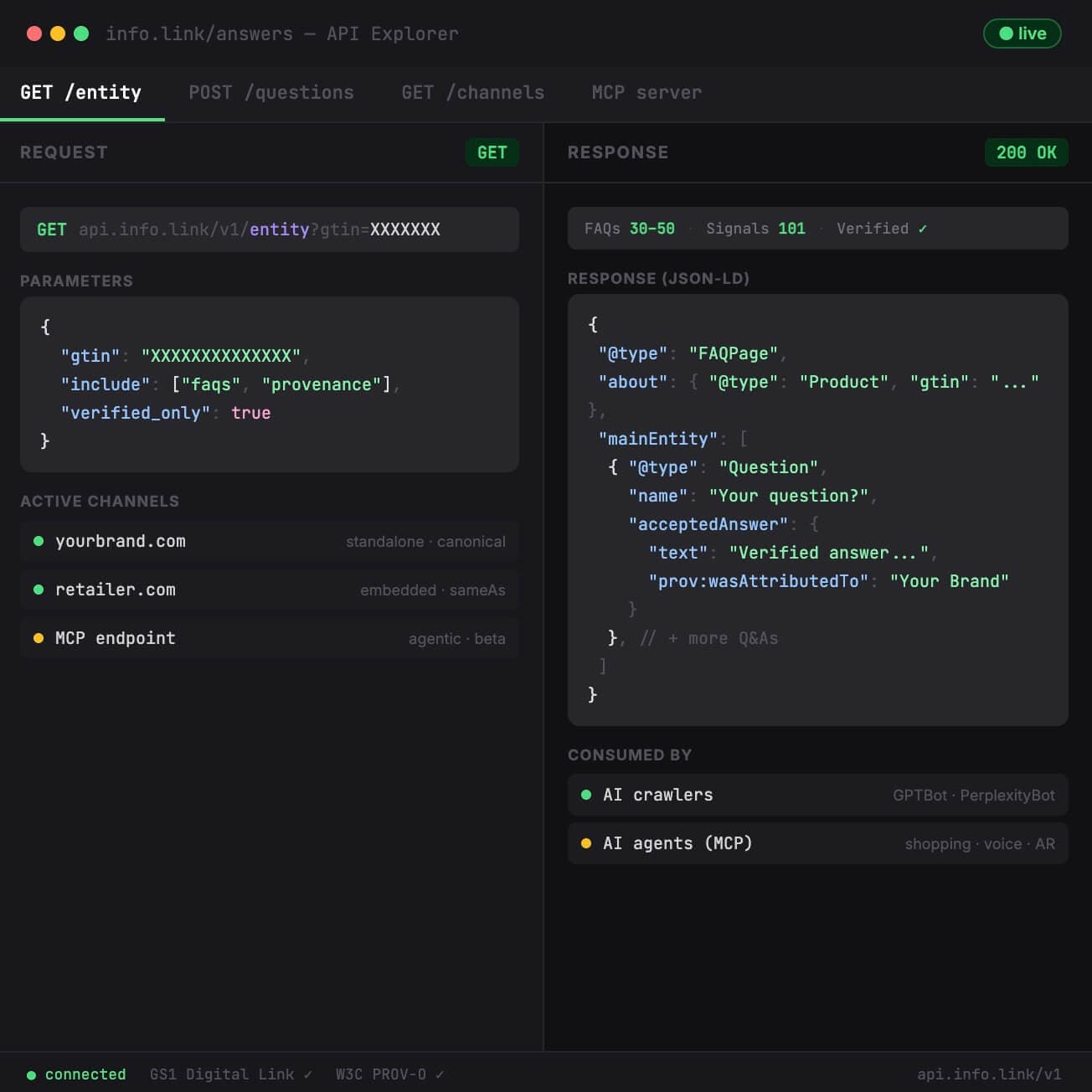
Ready for what's next
With structured product feeds like Google's Universal Commerce Protocol, product information can flow to any system in a machine-readable way. info.link/answers can serve as an API endpoint or MCP server, so any system that needs brand-verified product knowledge, from website chatbots to AI shopping agents, gets the right answers.
See where AI falls short on your products
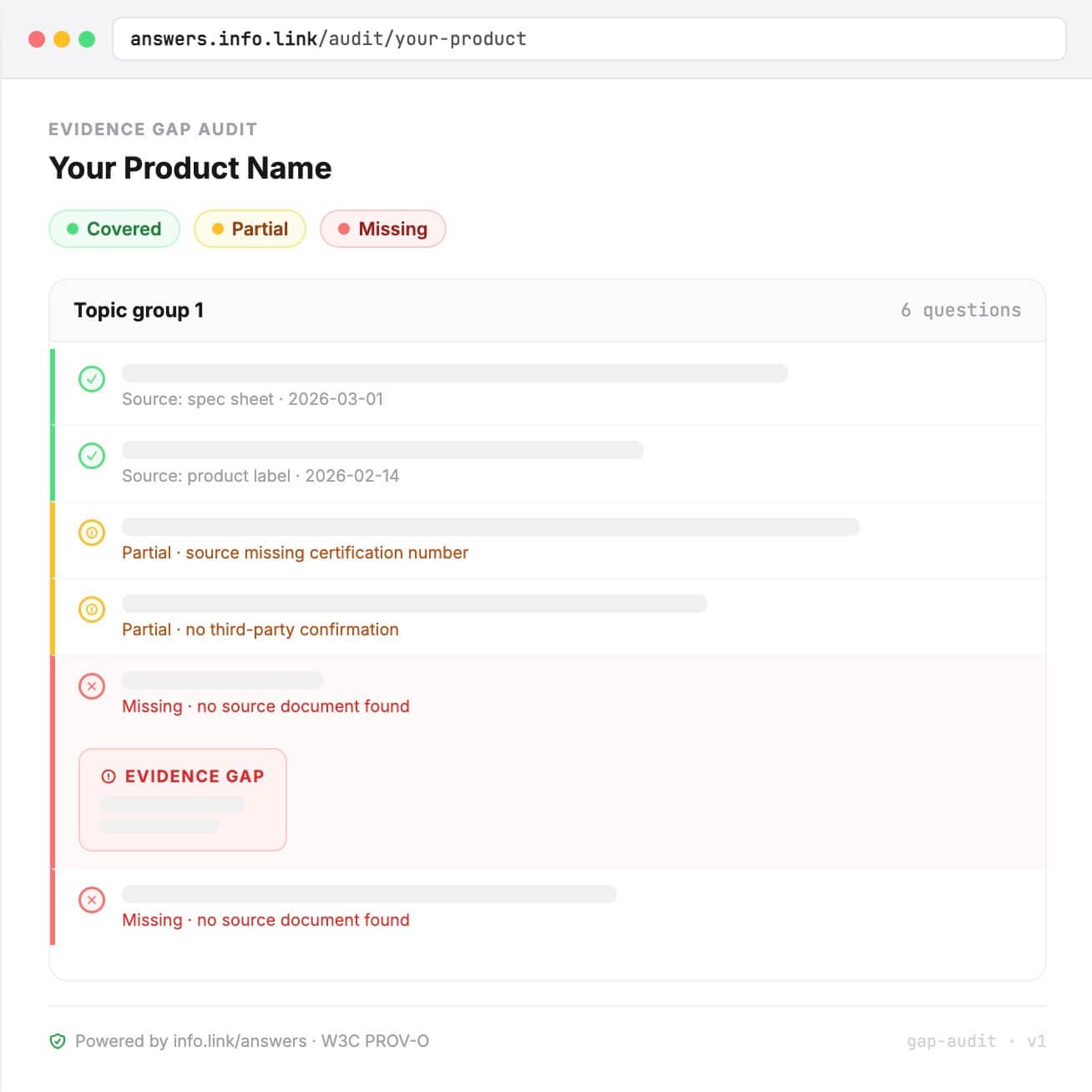
Before we write a single answer, we show you every question AI can't answer about your products today.
The platform analyses your existing source material against the questions consumers are actually asking. The platform scores each question for answerability: green means your sources cover it, amber means partial evidence exists, red means the data isn't there yet.
The result is a clear map of your evidence gaps, with specific recommendations for what source material to provide. Industry experts recommend starting with your highest-revenue products and unique differentiators where you want to establish AI category leadership before competitors do.
You can use this as an audit first and a content platform second. Either way, you'll know exactly where you stand.
The brands that get this right win.
“We are thrilled to be able to ensure that our products are more visible in AI results thanks to info.link/answers. By using GS1 standards, we help both our customers and our retail partners answer complex or sensitive questions about nevernot products and find answers.”
Katharina Trebitsch
Co-Founder, Nevernot
What happens when product data is structured for AI
$400K/mo
A supplement brand built machine-readable product content and became the top AI recommendation in 28 out of 50 key queries. The result: $400,000 per month in AI-referred revenue, converting at 4.4x the rate of traditional search.Source: Nate.Google
82% mention rate
An industrial manufacturer unified fragmented technical data into a structured, machine-readable format. They achieved an 82% mention rate in ChatGPT and 84% in Google AI Overviews, influencing over $90M in pipeline.Source: Daria Chetvertak, Top GEO campaigns of 2025
14.2% conversion
AI-sourced traffic converts at 14.2% on average. That's over 4x higher than traditional organic search at 2.8%.Source: Discovered Labs / SuperPrompt (2025)
Ready to link your products to the web and AI?
See how info.link helps leading brands meet compliance, engage consumers, and show up in AI search. Book your free consultation.
Book a demo